Not eligible for FMLA/CFRA: What to do?

UPDATE: This post has been edited to reflect 2018 updates to CFRA eligibility requirements, as well as increased benefit amounts for SDI and PFL.

Maternity leave in the United States already sucks as it is, but what do you do if you don’t qualify FMLA or CFRA? Currently, to be eligible for FMLA or CFRA you need work for an employer with over 50+ or 20+ employees, respectively. Further, both laws are only applicable to those who have been at their current employer for at least one year, and have clocked in at least 1,250 hours of work within the past year. So, what happens to employees who work at small companies or are new(ish) to their jobs? They don’t qualify. Lame!

But, have no fear, even without FMLA and CFRA, you will be entitled to some level of job-protected and paid maternity leave.

First off, in the context of maternity leave in California – don’t worry about FMLA. FMLA is – more or less – irrelevant in California since Pregnancy Disability Leave (PDL) supersedes FMLA. So, even if you don’t meet the FMLA eligibility requirements, you are eligible for PDL as long as you are a California employee who works for an employer with 5+ employees. There is no additional eligibility requirement for PDL, such as minimum hours worked or length of service. Thanks California for looking out for pregnant mommas!

To cut to the chase, here’s what a PDL-only eligible timeline for a typical, uncomplicated pregnancy and vaginal childbirth looks like.
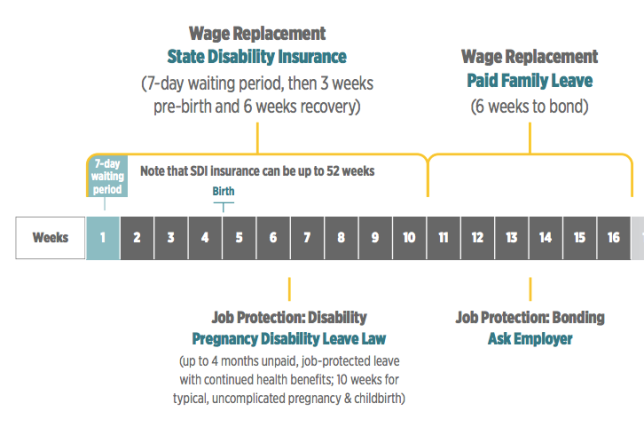
Screen Shot 2018-03-01 at 2.57.44 PMThe “Disability” portion of your leave

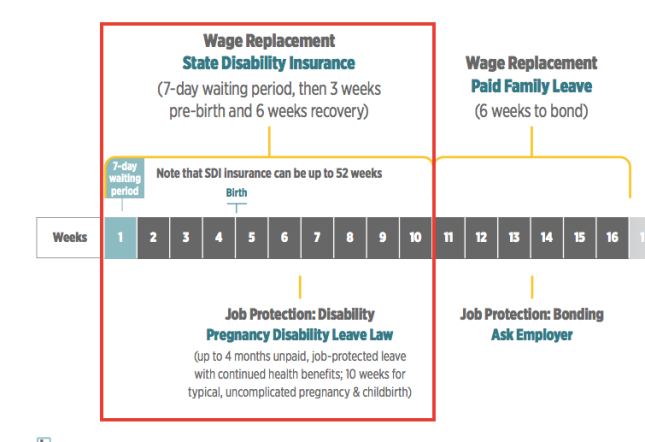
Let’s start by talking about the disability portion of your leave as highlighted below…
Screen Shot 2018-03-01 at 1.56.05 PM

PDL starts the first day of your disability (aka when your maternity leave starts), and provides up to 17.3 weeks of unpaid job protected leave for the purpose of pregnancy, childbirth, and other related conditions. You don’t automatically get all 17.3 weeks of leave. The actual duration of your PDL must be certified by your doctor, but the “default” duration of PDL for a healthy, uncomplicated pregnancy/childbirth is 4 weeks before birth and 6 weeks after for a vaginal delivery or 8 weeks after for a c-section. Should you have any complications during pregnancy (i.e. high-risk issues, preeclampsia, bed rest, etc) or post birth (physical issues, postpartum depression, etc), your doctor can certify an extension(s) beyond the “default” duration.

While PDL provides unpaid job protection for the duration you are “disabled” by pregnancy and childbirth, you may be eligible to receive wage replacement of either 60% or 70% of your normal weekly wage through State Disability Insurance (SDI). To be eligible for SDI benefits, you must have earned at least $300 from which SDI deductions were withheld during a previous “base period.”  Read this post for more information on the base period and how SDI is calculated.

The “Bonding” portion of your leave

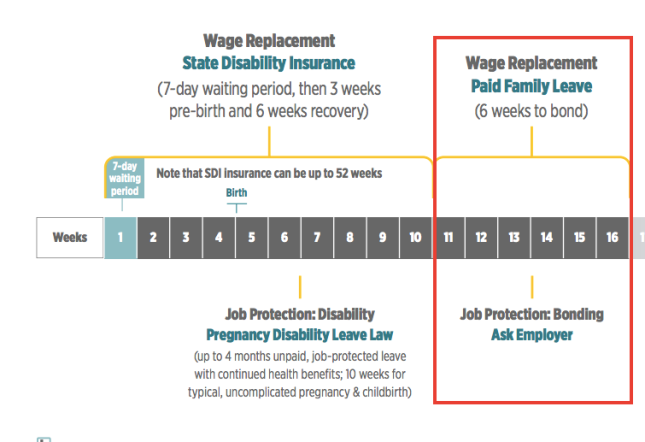
Now, we come to the unfortunate, tricky part of being only PDL-eligible….the “bonding” portion as highlighted below.
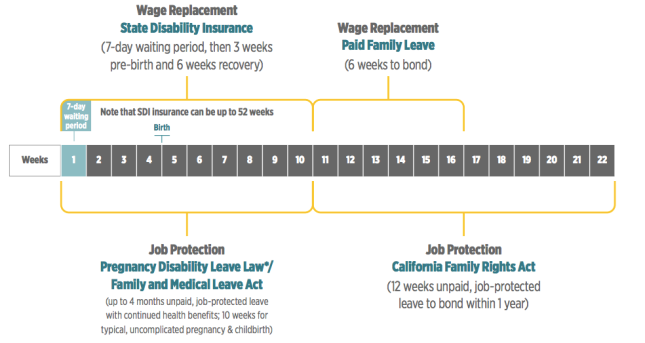
Screen Shot 2As comparison, here’s what a PDL/FMLA + CFRA eligible timeline for a typical, uncomplicated pregnancy and vaginal childbirth looks like.
FMLA CFRA eligible

Typically, when a mother is eligible for CFRA, following PDL/SDI she is entitled to an additional 12 weeks of unpaid job-protected leave for the purpose “bonding” with the baby. During these 12 weeks of CFRA, you can get 6 weeks of partial pay though Paid Family Leave (PFL) and the remaining 6 weeks are unpaid. However, if you don’t meet all the CFRA requirements below, you are not entitled to job-protected time off for bonding following PDL.

CFRA eligibility requirements:

  • Work for an employer with over 20+ employees within a 75 mile radius
  • Have worked at employer for at least one year
  • Have worked at least 1,250 hours in the last year

By now, it’s clear that you aren’t eligible for job protection under CFRA, but can you still access PFL? After all, PFL is something you’ve been paying into through CA SDI tax deductions. So, here’s the actual tricky part….By virtue of having paid into SDI taxes, you are technically eligible to claim PFL following PDL/SDI. However – the kicker is – since PFL is only wage replacement and does not provide job protection, you would need to be CFRA-eligible to have your job protected while taking leave to collect PFL. Crap!

[UPDATE: The maximum duration of PFL benefits will increase from 6 weeks to 8 weeks, beginning on July 1, 2020. This does not change the fact that PFL is NOT a job-protected leave of absence. You must still be eligible for CFRA in order for your job to be protected while taking time off to collect PFL benefits.]

But, even when law mandated job-protected leave is not available to you, you may be able to still request leave independent from CFRA from your employer. So, it’s definitely worth the conversation with your employer to see if they have any Leave of Absence (LOA) policies outside of CFRA. The other bummer is that without law-mandated CFRA, your request to take leave would be subject to employer approval. If you do happen to get approval to take non-CFRA leave, PFL is paid out at the same rate as your SDI benefit.

I know it’s not much maternity leave compared to say Croatia, which gives moms an entire year of full pay. But, at least you’re getting some time to prepare and be with your little one….even if you’re sleep deprived.

IMG_2832.2014-06-06_001612

If you have questions regarding California maternity leave, or would like more information on how I can provide individualized support to help maximize your maternity leave, please visit Maternity Leave 411.

If you are PDL/FMLA + CFRA eligible, read this post on how to Milk Your Benefits!

Pumping at Work: Tips for making it work

Pumping is a labor of love. It takes a lot of time and effort, but you press on (or pump on) for the sake of your child. While everyone has their own timeline for how long they want to pump – or chose not to pump at all – here are some tips that helped me while I pumped at work.

First, let’s review the laws shall we….In California:

  • Employers must provide employees with a reasonable amount of break time to pump. (Labor code: 1030)
  • Employers must make reasonable efforts to provide
    employees with the use of a room or other location for pumping. This does NOT include toilet stalls or bathrooms (that is against the law). Also, it must be in close proximity to the employee’s work area employee. (Labor code: 1031)
  • If you feel that your pumping rights are being violated in any way, file a complaint with California Department of Labor.

Now, for the tips:

1) Get your hands on a quality breast pump. I use the Medela Pump In Style Advanced and really like it. I found it to be just as strong as a hospital grade pump, making it super efficient. Only downside is that it’s pretty loud.

PRO TIP: The health care law requires most health insurance plans to provide pumps for FREE. The only caveat is that your choice of breast pumps may be limited depending on your carrier. Before you go out and buy one, definitely check with your insurance carrier to see which pump they cover.

2) A hands-free breast pumping bra is your BFF. These babies are essential for multitasking. Just strap in, pump, and email on! I like the Medela brand – it’s nice and snug, keeping pump parts in place, yet still comfy. They tend to run small, so best to size up.

3) A cooler and ice pack makes for easy transportation of your liquid gold. This cooler, which includes two ice packs, by Munchkin worked great for me, but any ol’ cooler is fine.

4) An easy way to disinfect your pump parts will save you a lot of time and energy. I should know because I did it totally wrong by bringing a different pumping set for each session – that’s SIX (flange, pump, and valves) different pieces to wash every night! No bueno. Instead, put your used pump parts in a ziplock bag and store in the fridge in between session. As long as the parts are kept cold, the risk of contamination is very low.

5) Make pumping a part of your workday routine. Work can get very demanding and distracting. Before you know it, you’ve completely missed a pumping session and you’re engorged and uncomfortable. Grrrrreeeaaaat. Avoid these snafus by slotting your pump times into your work calendar. By blocking out times, not only will it help you stick with it, it will also let colleagues know you are occupado (busy).

1344643224146_1060723

The colicky baby tool kit

You hear so much about the joys about being a new mother that no one really warns you about colic, the inconsolable crying that lasts for many many hours a day. Baby E had colic…in a major way. Pediatricians say most commonly it starts around the second week of life, but for Baby E, colic reared its ugly head in the second DAY of life. Sigh.

While there is no one absolute cure for colic (awesome!), there are ways to keep it maintained (and your sanity in check). My husband and I tried and bought just about everything that was available, so here are some of the best and effective tools that helped Baby E. I write this post in hopes that my experience and recommendations help you and your little one. 

1) Yoga ball. If you have a crying baby stop what you are doing and get a yoga ball! Colic or not, the best way to soothe a crying baby is to bounce. With Baby E’s endless crying fits all that deep bouncing was turning my quads into those of an American Gladiator’s. Not cute.

Thanks American Gladiators for the image!

Thanks American Gladiators for the image!

There’s something about the deep bouncing that’s soothing for the baby – maybe it mimics how it felt like in the womb? For the budget conscious parent who is torn about splurging on a glider, get a yoga ball instead and save yo’ money. I have many friends who get far more mileage out of their $15 yoga ball than any fancy rocking chair. Just sayin’…

2) Gerber Soothe Colic probiotic drops. Like many babies with colic, Baby E also suffered from gas and reflux discomfort. I’m not a doctor, so I don’t know all the facts about these “friendly bacteria” gems, but probiotics basically help aid in moving things along in the gastrointestinal system. Since adults use probiotics for the same reasons, I figured I’d give it a shot with Baby E (after I consulted her pediatrician of course). I’ll say with confidence that this was a game changer for Baby E – within a week, I saw a major difference in her level of crying and overall discomfort.

There are several brands of probiotics out there, but you want to make sure that the bacteria is specifically, Lactobacillus reuteri (L. reuteri). Also, as a heads up, the Gerber and the BioGaia brands are the same thing – Gerber bought the BioGaia probiotics.

3) Rock n Play Sleeper. This portable, light weight bassinet puts a sleeping baby at an incline, which is very helpful for babies with gas, reflux or other GI issues. In full disclosure, this thing is a little controversial generating debate as to whether a baby should be sleeping in this for extended periods of time….but, it worked for Baby E. Honestly, when you have a baby with colic, you’ll do anything. Even if it means breaking the rules or doing something that the “perfect mother handbook” tells you not to do. Happy baby = happy mom. End.Of.Story. Oh, btw, there’s a vibrating mode on these bad boys that Baby E loved!

Baby E catching some Zzz's in the Rock n Play

Baby E catching some Zzz’s in the Rock n Play

If you don’t want to clutter your space with yet another baby item, just roll up some towels and place them under the mattress of the crib or bassinet. The incline really helps in alleviating gas and reflux pains.

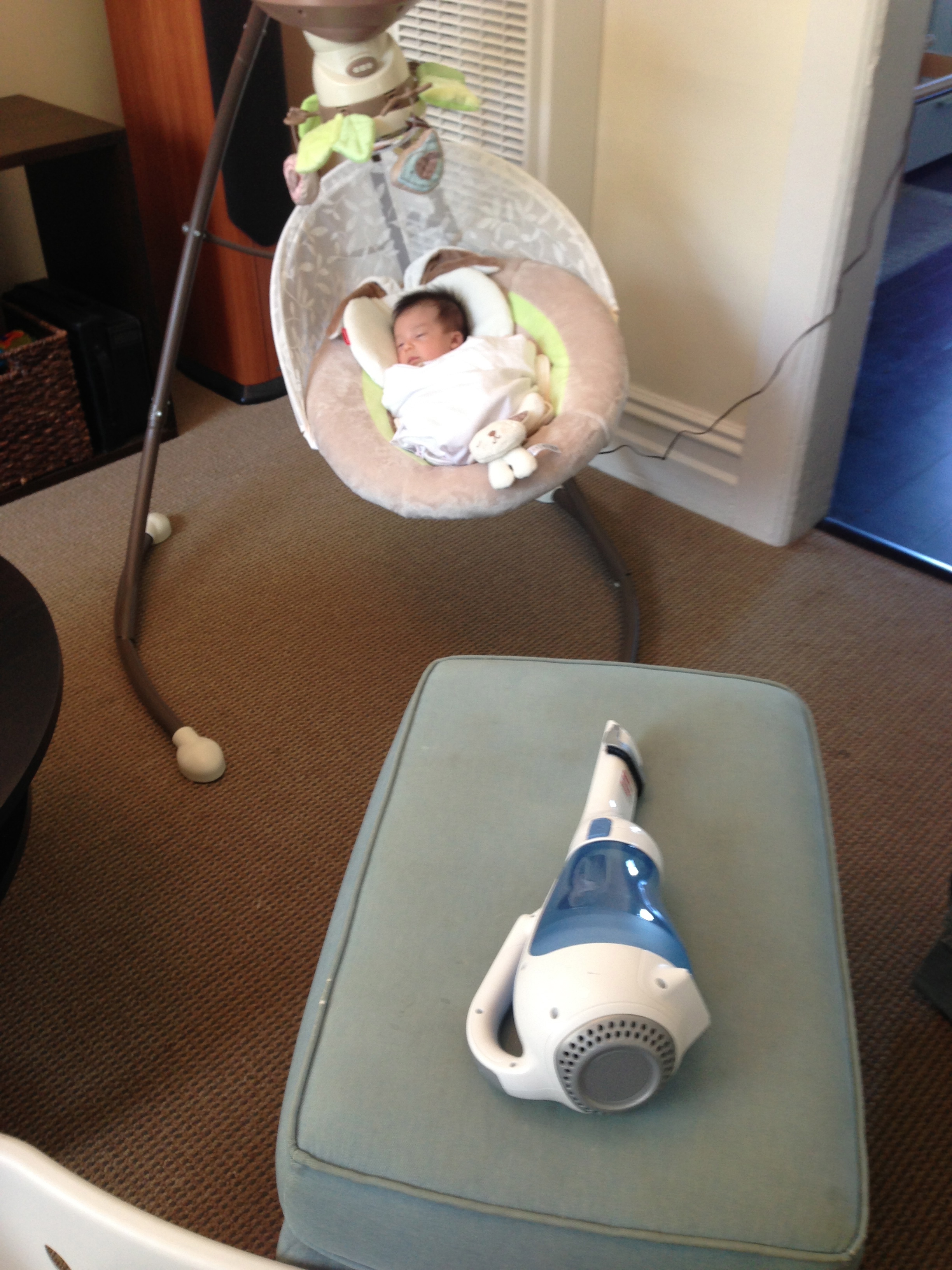
4) Sound machine. Babies love the sound of vacuum cleaners, static or driving. Weirdos.

I once actually had the mini vac running while she was sleeping. Slept like a baby.

I once actually had the mini vac running while she was sleeping. Slept like a baby.

Similar to the yoga ball/bouncing theory, I think these sounds remind them of when they were nestled up inside mamma’s belly. Come to think of it, maybe colicky babies are just pissed off about having been evicted from the womb, so they are retaliating by crying a lot….I digress

There are tons of white noise machines for babies out there, but why pay money when you can get them for FREE on your iPhone of iPad!? The Sleep Pillow app, available on iTunes, has over 70 different sounds from light to medium rain, mother’s heartbeat, to hair dryer. Crap, it even has one called “beach resort hammock” – and it sounds diviiiiiine.

5) Infant carrier or sling. Baby carriers are clutch for any new parent who wants to be mobile. But, for colicky babies who want to be carried all the time, a carrier is a lifesaver. I don’t care how strong you are, a 7-8 pound baby will get heavy after a while. For Baby E, I think it was the skin-to-skin closeness that set her at ease. Confession: I would often wear her shirtless to “maximize” on the skin-to-skin. You gotta do what you gotta do, amirite!??

We tried out several carriers. We used the Baby Ergo with infant insert when she was first born – it was fine, but I think she was just too small for that carrier. I had heard great things about the K’Tan wrap, so I tried that next. It was a little cumbersome to put on, but once she was in it, she seemed to like it.

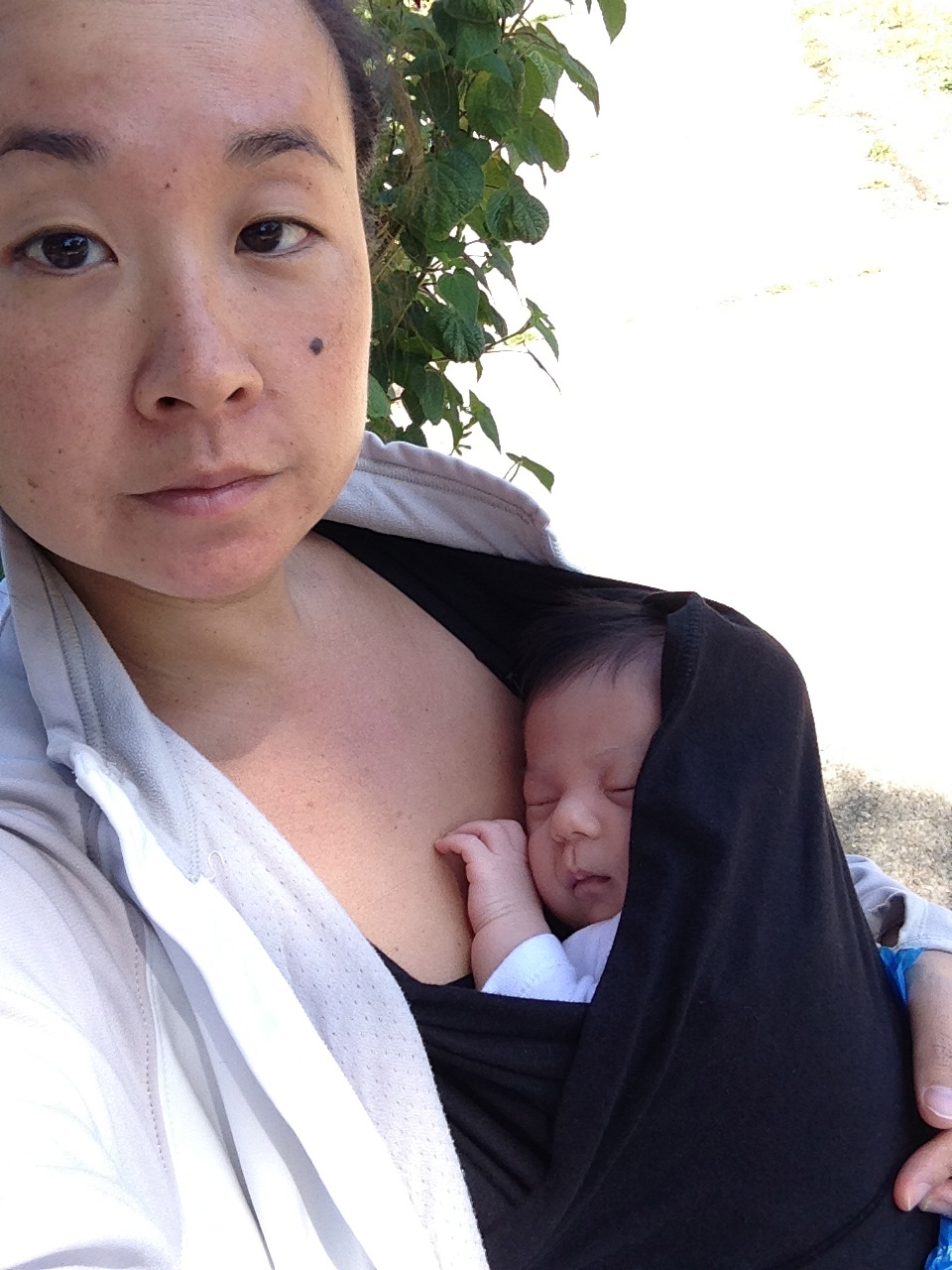
Baby E snug as a bug in the K’Tan. God, I look SO tired.

We’re currently using the Baby Bjorn now that she’s bigger, and that seems to work best for both me and Baby E. At the end of the day, any baby carrier that is comfortable for both you and the baby will do just fine.

6) Cranial Sacral Therapy. CST is “a gentle, noninvasive form of bodywork that addresses the bones of the head, spinal column and sacrum.” The thought is that the gentle massage of these areas will help in alleviating the points of stress, pressure and pain that may be leading to the colic/crying. I know what you are thinking: this is crazy; I know. It was so totally out of my comfort zone (it’s very hippy dippy), but it worked for Baby E. I was feeling pretty helpless and the glimmer of a promise that this would help improve things was reason enough for me!

When I went to the specialist in San Francisco, my first reaction was, “dude you are just touching my child’s face and head. I could have done that myself!” But, the reason why people paid him the big bucks was clear…it actually worked! Within just the first visit, I noticed a definite increase in her sleep duration, decrease in spitting up and gas discomfort, and crying. Even my husband who’s usually a totally downer about these types of things was impressed. He was a believer too – hallelujah!

As a heads up, check with your pediatrician to make sure that CST is the right move for your bambino. Also, call your insurance to see if you get partial or full coverage, as it’s not the cheapest service in the world.

Much like what our pediatrician told us, Baby E’s colic lasted for about 12 weeks before it kind of just suddenly turned a corner. Dealing with Baby E’s colic has been one of the hardest things I’ve ever had to do deal with. It’s tough, but it will end. I’ll promise you that.  Hang in there – you are doing amazing!

If you have any additional tips for colic, share them with the rest of us by leaving a comment. Sharing is caring!

It’s a New Year!

Happy New Year, everyone. I hope everyone had a restful holiday. I start this new year with a resolution….blogging.

I’m a first time mom to baby E (pic below…I mean, seriously, right? I just can’t), so I suspect much of this blog will be about baby stuff.

DSC_0812


But, I’ll throw in some general musings for good measure too.

So join me on my blogging adventures!

(Okay, in full disclosure, this first post sucked, but I need to get something in the books…)